


Astronomy
Explore the universe as it truly is — vast, ancient, and endlessly diverse. From the worlds of our own Solar System to the distant reaches of intergalactic space, every region offers something extraordinary. The cosmos is a gallery of wonders: majestic spiral galaxies unfurling their arms like celestial whirlpools, graceful ellipticals glowing faintly in the dark, and chaotic galactic mergers where gravity reshapes creation itself.
Each image captured here represents light that began its journey millions of years ago — a silent messenger from the universe’s distant past. To explore these galaxies is to step back through time and witness the unfolding story of cosmic evolution. Together, they form a celestial zoo of breathtaking diversity — a reminder that we are part of something infinitely greater, still revealing its secrets among the stars.
sSolar System
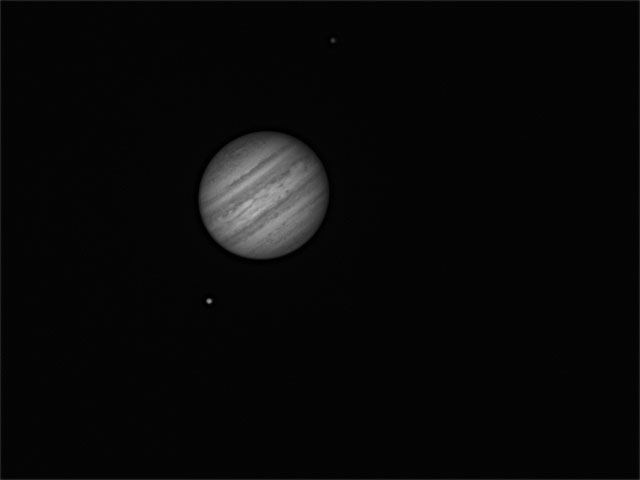
Jupiter
Jupiter was beautifully positioned in 2012 — high in the northern hemisphere skies in the early hours, around 02:00 to 03:00 UT. Its brightness made it unmissable, the most luminous object visible at the time. Imagers captured it using webcams or specialist planetary cameras like the Neptune 664C.
Programs such as Registax were then used to align, stack, and sharpen the best frames, producing detailed planetary images through the “lucky imaging” technique.

The Moon
Our planet’s only natural satellite orbits Earth every 29.5 days, appearing the same size as the Sun due to a cosmic coincidence: it is 400x smaller but also 400x closer. Without this perfect ratio, solar eclipses would never occur!
The Moon has been a companion to humanity since the dawn of time — inspiring stories, science, and exploration alike.

Saturn
Known as the “ringed giant,” Saturn is a spectacle through even modest telescopes. Its vast rings are composed of ice, rock, and dust, spanning over 270,000 km in diameter.
Astrophotographers often capture its fine ring divisions, such as the Cassini Division, and subtle atmospheric banding.

Mars
This image of Mars was captured using an infrared (IR) pass filter, which isolates wavelengths beyond visible red light. Infrared imaging reduces the effects of atmospheric turbulence, revealing sharper surface details even under less-than-ideal seeing conditions.
The dark albedo features near the equator — such as Syrtis Major — contrast beautifully with the brighter southern polar region. The IR spectrum also enhances surface contrast, highlighting dust storms and atmospheric variations that are often lost in RGB images.
Captured during the 2022 apparition, this was one of several imaging sessions that demonstrated how powerful IR imaging can be for planetary astrophotography.

Jupiter — Captured with the Neptune 664C
This image of Jupiter was taken using the Neptune 664C colour planetary camera, a sensitive sensor ideal for capturing fine atmospheric detail in RGB. The planet’s iconic belts and zones are clearly visible, along with subtle variations in hue caused by different cloud layers and chemical compositions.
On the left, one of Jupiter’s Galilean moons is visible — a reminder of the dynamic system that orbits the gas giant. Capturing these details requires high frame-rate imaging and careful stacking of thousands of frames to overcome atmospheric turbulence.
The result is a crisp, natural-colour portrait of the solar system’s largest planet, showcasing both its immense scale and delicate atmospheric motion.

The Moon — Clavius Crater in Infrared
This detailed image of the lunar surface shows the Clavius crater, one of the largest and most impressive impact structures on the Moon. Captured using an infrared pass filter, the image benefits from reduced atmospheric turbulence, revealing crisp surface relief and fine crater wall structure.
Infrared imaging enhances contrast between the lighter highland material and the darker basaltic regions, making subtle elevation differences and small crater chains visible. The clarity of this view demonstrates how IR techniques can overcome poor seeing conditions and deliver near-spacecraft-quality lunar detail.
Clavius lies in the Moon’s southern highlands and spans over 230 kilometers — a stunning reminder of the Moon’s violent early history and a favorite target for high-resolution astrophotography.
Stars

The Life of an Enormous Star
UY Scuti is one of the largest known stars in the observable universe — a red supergiant of almost unimaginable proportions. If placed at the center of our Solar System, its fiery surface would extend beyond the orbit of Jupiter, engulfing Mercury, Venus, Earth, and Mars with ease. The scale defies human comprehension; compared to our Sun, UY Scuti is not merely larger — it is an entirely different magnitude of existence.
This image illustrates that immensity: the tiny dot representing the Sun, dwarfed into insignificance by the vast, swelling atmosphere of UY Scuti. It serves as a humbling reminder that even our most powerful star — the one that sustains all life on Earth — is but a spark in the grand stellar ocean.
Observing stars like UY Scuti offers a glimpse into the ultimate fate of massive suns — luminous titans nearing the end of their lifespans, destined to collapse and seed the galaxy with the heavy elements that build planets, and perhaps, life itself.

Star Classification
Stars have always captured human imagination — glittering beacons that guided our ancestors, marked the seasons, and inspired myth and science alike. They come in an astonishing range of sizes, colours, and luminosities, each one a furnace of physics shaping the universe we see today.
For centuries, stars were classified only by how bright they appeared in the night sky — their apparent magnitude. It wasn’t until the early 20th century that Ejnar Hertzsprung, a Danish astronomer, revolutionized this view. He began categorizing stars by their absolute magnitude (true brightness) and colour, which directly relates to temperature. Hertzsprung also determined the intrinsic brightness of Cepheid variable stars, providing a crucial rung on the cosmic distance ladder still used today.
At the same time, across the Atlantic, Henry Norris Russell was bringing the “physics” into astrophysics. A gifted mathematician, Russell studied stellar parallax and binary star systems, noticing how their colour and luminosity changed over time. When he plotted these properties on a graph, he rediscovered Hertzsprung’s relationship — that blue stars are hotter and more luminous than yellow or red ones. Yet he also noticed exceptions: the giant stars, immense and bright despite their cooler temperatures.
By combining their insights, Hertzsprung and Russell created what we now call the Hertzsprung–Russell Diagram — a cornerstone of modern astrophysics. It reveals the life cycle of stars, from the searing blue giants to the fading red dwarfs.
Our own Sun, a modest G2V star, sits comfortably in the middle of the diagram’s “main sequence.” In many ways, we’re fortunate it’s such an ordinary, stable star — the quiet kind that makes life possible.

M13 — The Great Hercules Cluster
Messier 13, better known as the Great Hercules Cluster, is the largest and brightest globular cluster visible in the northern hemisphere. Located some 25,000 light-years away, this dazzling ball of ancient stars contains more than 300,000 suns packed into a region only 150 light-years across.
Globular clusters like M13 are among the oldest structures in our galaxy — relics from the early days of the Milky Way’s formation, over 12 billion years ago. The densely packed core is so bright that individual stars blur into a silvery glow, while the outer halo fans out in a faint shimmer of orange and blue points — cooler red giants and hotter main-sequence stars side by side.
Even through a modest telescope, M13 is breathtaking. In astrophotography, long exposures reveal its true depth: a glittering spherical swarm suspended in the dark — a timeless reminder of our galaxy’s ancient past.
Nebulae & Galaxies

The Horse Head Nebula
Few nebulae are as iconic as B33, the Horsehead Nebula, silhouetted against the glowing expanse of ionized hydrogen in the constellation Orion. This striking dark nebula lies some 1,500 light-years away, nestled within the vast Orion Molecular Cloud Complex — a stellar nursery where new suns are born.
Seen here through a hydrogen-alpha (Hα) filter, the view isolates light emitted by energized hydrogen atoms, revealing the intricate structure of the surrounding emission nebula IC 434. The Horsehead itself is a dense column of cold gas and dust, its shape sculpted by intense radiation from nearby massive stars, most notably Sigma Orionis.
In monochrome Hα, the Horsehead takes on a haunting, almost three-dimensional quality — the delicate interplay of shadow and glowing gas hinting at the complex dynamics within this stellar nursery. It remains a timeless target for both professional observatories and dedicated amateur astrophotographers alike.

NGC 7023 — The Iris Nebula
The Iris Nebula (NGC 7023) is a stunning reflection nebula located about 1,300 light-years away in the constellation Cepheus. Its central blue glow is caused by starlight from a young, hot star scattering off surrounding interstellar dust — a cosmic mirror that paints the darkness with subtle hues of blue and silver.
Unlike emission nebulae that shine through ionized gas, reflection nebulae like the Iris simply borrow light, their beauty revealed through contrast and texture. The surrounding region is rich in dark molecular clouds, part of an extended complex of dust and gas that hides countless forming stars within.
Capturing the Iris requires both patience and precision. The faint, filamentary dust that surrounds it is best revealed through long-exposure imaging and careful processing — a perfect example of how light and shadow intertwine to reveal the quiet artistry of the cosmos.

The Rotten Fish Head Nebula
Hidden deep within the constellation Cepheus, LDN 1251 — affectionately called the Rotten Fish Head Nebula — is a striking example of a dark nebula: a dense, cold cloud of interstellar dust that blocks the light of the stars beyond. Its distinctive shape and subtle glow make it a fascinating study in cosmic shadow and light.
Unlike emission or reflection nebulae that shine or scatter starlight, dark nebulae are visible only by contrast — they appear as voids against the rich star fields of the Milky Way. Yet, within their depths, the seeds of future stars are quietly forming, hidden from view in cocoons of gas and dust.
This image captures the complex texture of LDN 1251: faint whisps of interstellar dust illuminated by distant starlight, subtle blue reflection zones, and the dark lanes that give the nebula its haunting silhouette. These quiet regions remind us that even the darkest corners of space are alive with creation.

Grand Design Spiral in Coma Berenices
Messier 100 (NGC 4321) is a magnificent grand design spiral galaxy located around 55 million light-years away in the Virgo Cluster. Its beautifully symmetrical arms, traced by countless blue star clusters and dust lanes, make it one of the finest examples of a face-on spiral visible from Earth.
M100 is a stellar metropolis, home to hundreds of billions of stars and several supernova remnants observed over the past century. The tightly wound arms are bright with regions of active star formation, glowing in pinkish hydrogen emission as young, massive stars ignite their surroundings.
Captured here in exquisite detail, the subtle halo and faint outer structures reveal the galaxy’s interactions with its cluster neighbors. To its right lies a smaller, edge-on spiral — a silent reminder of the gravitational dances taking place in the crowded Virgo Cluster.

The Leo Triplet
The Leo Triplet — a magnificent grouping of three spiral galaxies about 35 million light-years away — offers one of the most captivating views in the spring sky. Though separated by vast distances, their mutual gravity subtly links them, shaping their forms over millions of years.
From left to right, the triplet is made up of NGC 3628 (the “Hamburger Galaxy”), M66, and M65. Each displays a distinct orientation: M66 shows rich spiral arms warped by tidal interaction, M65 appears more serene and tightly wound, while NGC 3628 reveals a dark, thick dust lane cutting across its disk — evidence of past gravitational encounters.
This region of Leo is a deep-sky treasure, beautifully illustrating the elegance and complexity of galactic evolution. To the eye through a telescope, they appear as faint smudges; but through the camera’s patient gaze, the delicate arms and dust lanes reveal the silent, graceful dance of galaxies through time and space.

The Cigar Galaxy and Its Supernova
Messier 82 (M82), often called the Cigar Galaxy, is a turbulent, starburst galaxy located about 12 million light-years away in the constellation Ursa Major. Gravitational interactions with its larger neighbor, M81, have triggered intense regions of star formation — the bright, red plumes of hydrogen gas bursting from its core are driven by powerful stellar winds and supernova explosions.
The crosshairs mark the site of Supernova 2014J, one of the brightest and closest Type Ia supernovae observed in recent decades. Detected in January 2014, it briefly outshone the entire galaxy, offering astronomers an invaluable opportunity to study this kind of thermonuclear explosion in remarkable detail.
M82 is a galaxy in chaos and rebirth — a cosmic forge where stars are born, live brilliant lives, and die violently, enriching the interstellar medium for future generations of stars. Through the eyepiece, it appears as a faint cigar-shaped smudge; through the camera, its raw, energetic nature is fully revealed.